Life in PNG |
|
During a translation consultant check for the book of Exodus, I (Harold) noticed a passage that stood out to me: “Why, Lord! Why have you brought all this trouble on your own people? Why did you even bother to send me? Ever since I came to Pharaoh as your spokesman, he has been even more brutal to your people. And you have done nothing to rescue them!” Exodus 5:22–23 Moses’ complaint comes right at the beginning of a very familiar story—the one where God had called to Moses from a burning bush and told him to go to Pharaoh and speak for the Israelites who were slaves in Egypt. Moses obeyed and went before Pharaoh. Since God had promised He would deliver the Israelites, Moses probably expected this deliverance would happen right away. But, on the contrary, Pharaoh refused to release them and actually made things harder for them.
It seems Moses’ cry in this passage was one of frustration, but he could not see that God was doing something in the middle of all of this trouble.
“Now, Moses, you will see what I will do to
Pharaoh: Because of my mighty hand he will let them
go; because of my mighty hand he will drive them
out of his country.” Encountering this passage was encouraging. We are certainly not facing slavery like the Israelites, but ministry does come with challenges, and often the challenges are not always what we had expected. Though we can’t always know what God is doing, we’re confident He is doing something for good.
|
Ministry in Alotau |
|
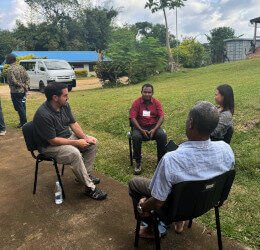
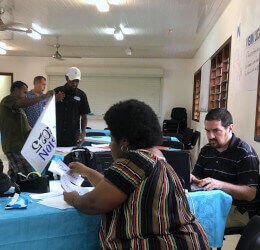
UCPIR, the church we are working with here in Papua New Guinea (PNG), has experienced many challenges in their translation ministry. Transportation from island to island is by boat or dinghy, so weather and rough seas can delay or hinder travel. Communication is challenging due to lack of power or unreliable power and limited network connectivity. Even where power and connectivity exist, many Papua New Guineans have had limited training with computers and struggle to know how to use them. At the regional office, the church has experienced significant turnover in leadership over the last several years. This makes continuity of vision and direction challenging. Yet, in spite of these difficulties, we are confident that God is working even when we don’t understand it.
|
FIA Workshop in Atlanta |
|
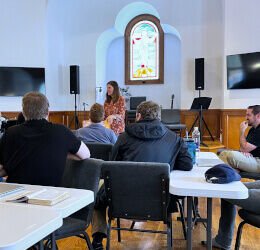
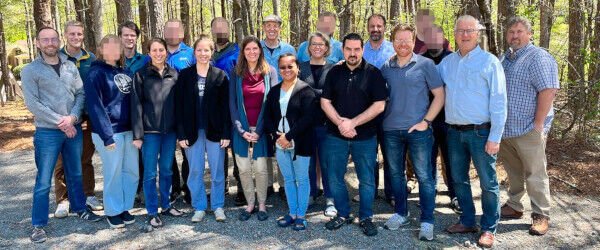
In April, I (Harold) returned briefly to the US for a workshop with my Convergence cohort. This training was designed to give our cohort experience with Oral Bible Translation (OBT). OBT is often used in areas where literacy rates are very low and helps make participation in the translation process possible for people who may be articulate and poetic in their language but who are not literate.
The first week of the workshop, my cohort explored an OBT methodology called FIA (Familiarization, Internalization, Articulation). The second week, we participated in a content sprint, helping to produce commentary materials on the Epistles for people who are not native English speakers. These materials will be used to help translators understand these Scripture passages so they can more accurately translate them.
|
CBBT Workshop in Vanuatu |
|
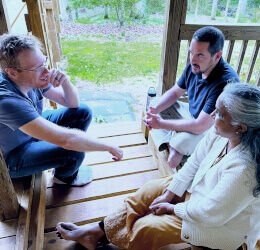
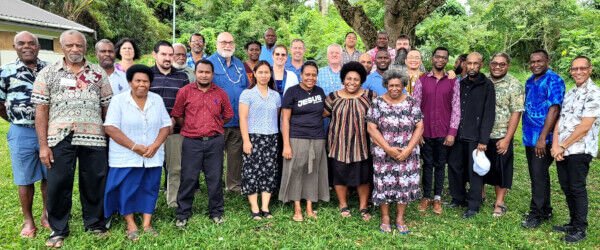
In May, I (Harold) assisted with a workshop in Vanuatu where local church leaders were presented a process called Church and Community Based Bible Translation (CBBT; See also this). This is the process that is being used in Milne Bay. It provides a plan for churches to take on Bible translation as a ministry using the FIA OBT methodology. Facilitators from North America, Africa, Asia, and Australia (a total of at least ten countries) taught processes to help develop the church’s capacity to do Bible translation for themselves. I presented on aspects of quality in translation.
|
FAQs About Life in PNG |
|
Where do you live?
What kinds of food do the local people eat?
What do you eat?
What is the weather like there?
What do Sundays look like?
How does PNG celebrate Easter?
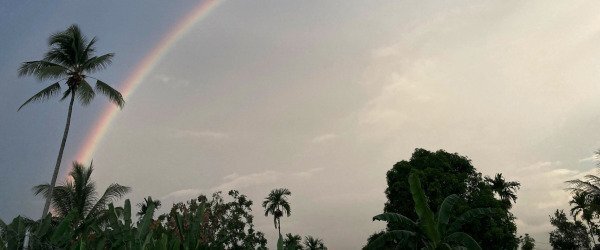
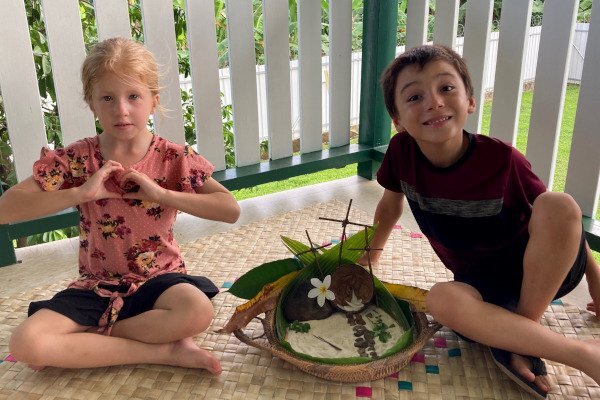
We made our annual resurrection garden this past weekend with whatever we could find in nature. The tomb is half of a harvested coconut and it’s the first time we used sand instead of dirt but the message is still the same: He is not here! He is risen! When we awoke on Easter morning and walked outside, this is what we saw. We trust it’s a reminder to you, too, that He always keeps His promises.
“If I ride the wings of the morning,
|
How to PrayWe had some hard but necessary conversations with the church and a new translation coordinator was appointed. As this relationship develops and grows, we trust it will help pave the way for healthy communication and camaraderie as we work together to see God’s name glorified in the earth through Bible translation. We’ve hosted meals, afternoon tea, and meetings from early til late most days. We’re exhausted yet hopeful and have repeatedly seen evidence of God’s nearness. Thank you for your prayers and partnership with us. Your partners, Harold, Justine, A’zalea, & Andrew |
|
Partner With Us
We praise God that He has been faithful to care for our financial needs in the past and are trusting that He will continue to do so in the future. If you are not already, would you consider being a part of what God is doing in Bible translation by partnering financially with our ministry? You can give a single donation or set up regular online giving here.
You may also mail a check to:
Ripe for Harvest If you are giving by check, please make it out to Ripe for Harvest with “Ministry Account #20542” in the memo line. Contributions are solicited with the understanding that Ripe for Harvest has complete discretion and control over the use of all donated funds. |
|
Update:
In 2026, we transitioned from Wycliffe USA to Ripe for Harvest
as our sending organization (see
here). Because of this transition, the
giving information in this newsletter includes references to
Ripe for Harvest along with our current contact information.
|
| ||||